
VETERANS DAY: The war hero with local ties you might not know
Medal of Honor denied Miller despite his actions in the South Pacific
By DONNA THORNTON, Editor
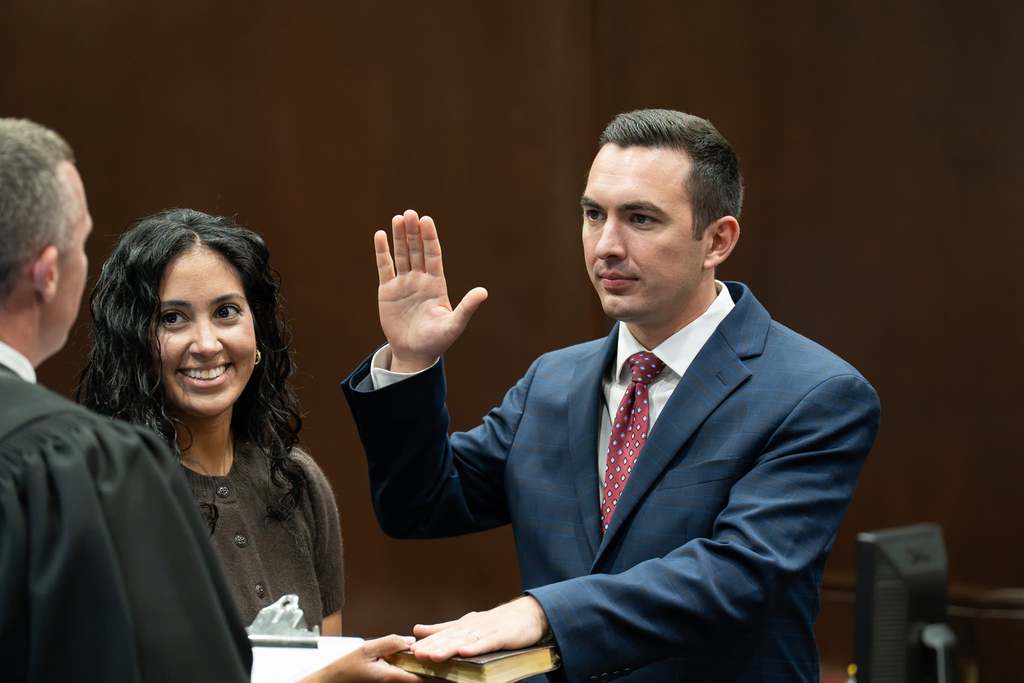
When Marshall County Circuit Judge Mitch Floyd spoke to Albertville Rotarians this fall, he led with a question: Had any of them heard of Hugh Barr Miller Jr.?
None of them had, and that was one of the reasons for the topic of his talk.
Floyd learned about Miller through a University of Alabama alumni magazine story, and then learned that Miller had a Marshall County connection. When he shared the story with Judge Chris Abel, the name was familiar to him: Abel delivers firewood to people in the Guntersville area; one of them was named Hugh Miller. When Floyd called the firewood customer, he found he was the grandson and namesake of the World War II veteran.
That connection and the compelling magazine story, by Lt. j.g. Scott Gold, Class of ’26, edited by Jennifer Stroud, Class of ’24, led him to research the World War II veteran and to share the history of someone Floyd believes should have been a Medal of Honor recipient.
Hugh Barr Miller Jr. was born in 1910 in Tuscaloosa, the son of a Mississippi lawyer, Floyd said, and his maternal great-grandfather had been the third president of the University of Alabama. According to the alumni magazine story, Miller’s great-grandmother, Louisa Garland, is credited with saving the President’s Mansion when Union troops torched the campus in 1865.
Miller Jr. attended Alabama, and tried out for Wallace Wade’s Crimson Tide, working his way from seventh string to the varsity team in 1929 and the undefeated 1930 team that won the 1931 Rose Bowl. It was Miller’s last game; he married and enrolled in law school, graduating in 1933.
He was practicing law in Pensacola, making a good living, when World War II broke out. “He used his connections to get himself in as an officer in the Navy,” Floyd explained, and he was sent to Key West. Miller was in his 30s. At the time, German U-boats kept attacking merchant ships in the Caribbean, the Gulf and the Atlantic.
“He wanted to get in on the action,” Floyd said. “So he used his connections to get himself on the USS. Strong, a Fletcher-class destroyer commissioned in September 1942, and found himself headed for the Pacific, when the ship saw action.
“The plan at the time was island-hopping. Guadalcanal was taken in February of ’43, and the Solomon Islands were very important to the Allies,” he said, as the connection to the north of New Zealand and Australia and to the east to New Guinea. “It was a very strategic point for the Allies.”
The Japanese controlled a horseshoe-shaped string of islands in the Kula Gulf, Floyd explained. To “soften up” the islands, Allied ships were running task forces – destroyers and cruisers – into that gulf bombing both sides.
One of those runs headed out July 4, 1943, unaware that the Japanese were trying to restock and reinforced New Georgia. Two Japanese ships with radar saw the activity.
“They decided discretion was better than valor and turned to get out of the Gulf, but fired some parting shots,” Floyd said, using better torpedoes than anyone else had. “From 11 miles away – recorded as the longest torpedo shot to sink a ship – they fired 14 torpedoes and one of them hit the Strong right in the center.
Miller was in the catbird seat, watching, the judge said. He was machine gun officer and the third-oldest man on the ship. He saw it coming, and headed down, as efforts began to try to evacuate the ship. The Strong went down fast.
“It sank in 25 minutes,” Floyd said. The Chevalier came alongside and took on 241 of the sailors and officers, leaving 83 unaccounted for. Miller saw sailors on the starboard side of the ship – where it was listing – trying to ensure the live depth charges would not go off, impacting the ship and the rescue effort. He went to help.
Two men got caught in the net, and the Chevalier bumped the Strong, making it list even harder. The men were forced into the water and were trapped in the net. The Strong went down and the depth charges on the port side started going off.
The explosions lifted the Chevalier completely out of the water.
Miller ended up on the net, floating with debris and some 23 men. “They floated for four days,” Floyd said, before they washed up on Arundel Island.
Four were in good shape and they put together a raft, sending them out for help. Before dawn July 5, 1943, three more of the healthiest were sent on a rescue mission. That left 15, most of them “pretty badly injured, including Hugh.” Another died shortly after, then another. “They got down to six,” before they washed up on Arundel Island.
Another died that morning, while the rest tried to find a good hiding place in the jungle on the 6-mile-wide, 10-mile-long island. The Japanese were on the watch.
The men found a hiding place, Floyd said, about 300 yards away from where the Japanese patrolled. The survivors were short on supplies and in need of fresh water.
“Hugh thought he was dying. He was really struggling with his legs; he had internal injuries.” He and another sailor were in bad shape, Floyd said.
Miller, a lieutenant, was the only officer among the survivors. He was just 33 years old, but was 10 years older than any of the others. He sent some of them to look for fresh water. They found a spring, but it was near a Japanese lean-to, as the enemy was using the water source, too. “They had to be very cautious.”
Another shipmate died, and around July 15, Miller was still bleeding, in bad shape. He didn’t think he would make it. On the morning of the 16th, he told the three other survivors to go get help. They refused but he ordered them to leave.
With the low tides on Arundel, they could wade across to New Georgia. The Allies had invaded there. Crossing to them was the only way he could be rescued and survive.
Miller gave one of them his shoes and they went, leaving him under a mangrove tree with six coconuts, two beer bottles filled with fresh water, and an inch-and-a-half blade from a pocket knife.
“He thought, ‘I’m not going to make it.’” Believing the night of the 16th would be his last, he drank all of his water. “He woke up on the 17th feeling great,” Floyd said, as good as he’d felt since being on the ship. “But he was out of water.
“And he prays, ‘Lord, if you will just send me some fresh water or get me to a spring, I will not quit.’ He took a nap and he woke up to rain.” He used leaves to catch water and collected it in his bottles.
As Floyd related, Miller stopped feeling sorry for himself and began to feel hardier. “He didn’t have any shoes; he had a knife and he had some coconuts and that was about it.”
He decided to set up in a different place so he could observe the Japanese. That way, if Miller was rescued, he would have information about the enemy’s location and movements.
Miller found a tree with branches that grew up into a Y. “He could get up about 30 feet and observe the beach area,” Floyd said. “So he’s starting to watch the Japanese offload troops, their barges coming and going.”
On Aug. 3, 1943, a U.S. PT boat staged a sneak attack against Japanese barges, the judge explained. That gave Miller hope of being rescued. The next morning when he went out to get fresh water, he spotted a dead Japanese soldier, washed up on the beach.
After dark, he went out to the body. “He gets some rations, he gets his boots, a bayonet, some bug salve, and he gets two hand grenades.”
On Aug. 5, he woke up to artillery fire. “He snuck down to the beach and was watching. He saw a five-man patrol coming. He’d had enough of being hunted. He knew the territory now well,” Floyd said, and Miller knew there was a spot where the patrol would have to huddle together to get through the bushes. He waited until an American plane was flying over … and he used a hand grenade to kill all five Japanese.
That let him resupply. The guns had been destroyed, but he got more grenades, knives, and rations, and more intelligence off the soldiers. He buried the bodies so the Japanese wouldn’t find them – hoping they would think the patrol got bombed by U.S. planes.
“He got a razor and some soap, so he took his first bath in the longest time, since July 4th.”
After eating, on Aug. 9, Miller attacked one of the enemy machine gun nests under the cover of American artillery fire. He killed four more, then went back to the foxhole the next day and the bodies were gone.
On the night of Aug. 12, he did the same thing, and again, when he went back the next day, the bodies were gone and there was nothing he could scavenge.
“He’s starting to run low on weaponry at this point. But he also noticed there was an intensified effort on patrols,” Floyd said. “They knew that he was there.”
On Aug. 13, two 15-man patrols came out and he watched. Miller saw the patrol keeping to a familiar pattern – spreading out so they not all be jumped at once. On Aug. 14, he executed another foxhole attack.
“But this is the first one where he didn’t land his grenade in the foxhole. So two guys were still alive,” Floyd said, and he had to use two more grenades to take them out.
By now, Miller was running low on grenades, and the Japanese knew he was there. On Aug. 15, three 60-man search teams come out looking for him.
He hid in a hole by a log, covering himself with leaves. “At one point he could hear them walking over him, and one of them stuck a rifle tip, ruffling the leaves over him.”
By now, Floyd said, Miller knew his time was short. The next morning he went to the beach, to see if any other bodies had washed up, trying to find more grenades.
“And U.S. plane flew over. So he just took his chance. He ran out onto the beach in the open and waved his arms,” Floyd said. The plane tipped its nose and pointed the 50-cals at him. The pilot saw him, and realized, he said later, “that there’s no Japanese with a red beard.”
The plane waved its wings at him. They didn’t radio in, fearing the Japanese would be listening. They went back to their station and sent an amphibious “duck” plane to get him.
It landed and he ran out. They were so excited to rescue him that they almost messed up. “They had to crank the duck plane to get it started. They started to take off and realized they’d dropped anchor. They almost tore the wing off the plane,” Floyd said.
But the rescue was made, and Miller made his way back to celebration, receiving the Navy Cross — pinned on him Sept. 13, 1943 by Eleanor Roosevelt, who was on tour with Admiral William Halsey. It was the second-highest honor for military servicemen.
“The intelligence he gathered … all panned out and was very integral in us capturing the Solomon Islands. It saved many American lives.
“Admiral Halsey later retired, and he always thought Hugh should have got the Medal of Honor,” Floyd said. He campaigned for it, writing letters. Floyd said he doesn’t know it to be true, but in talking to Miller’s family, Admiral Halsey and Admiral Arley Burke weren’t the best of buddies.
In 1957, Burke was chief of Naval operations and the new Secretary of the Navy was Thomas Gates. Apparently, there was a rule that the Medal of Honor had to be given within five years after the act it recognized. Sen. Lister Hill from Alabama, brought a special Senate bill asking that the rule be waived to award Miller.
The Senate passed it, but the Secretary of the Navy got it torpedoed, Floyd said, adopting Burke’s words in a letter opposing it.
“The award of the Medal of Honor requires that the nominee must have distinguished himself conspicuously by gallantry and intrepidity, at the risk of his life above and beyond the call of duty. In wartime, there’s often no opportunity for those qualities to be observed by others. The essential elements and requirements for the Medal of Honor are not present and we disapprove any award of the Medal of Honor for Hugh Barr Miller Jr.,” he wrote.
“He was by himself and couldn’t be observed, so he didn’t get the Medal of Honor,” Floyd said. Miller died in 1978.
Floyd said Miller was featured on the show “This is Your Life,” and the regular host was sick. Ronald Reagan filled in, he said. His story was featured in Life magazine, and included in a number of military history books and comic books, as well as a biography written by Miller’s son.
“(He’s) probably the most deserving Medal of Honor recipient that is not,” Floyd said. “Fascinating story.”
To learn more about Miller, or to order the authorized biography of Miller written by Landon C.G. Miller, visit https://lthughbarrmillerjr.com.
Hugh B. Miller Jr., center, meets U.S. Navy Adm. William ‘Bull’ Halsey Jr., left, and first lady Eleanor Roosevelt when Roosevelt presented him the Naval Cross during her 1943 tour of the South Pacific. SPECIAL TO THE LEADER
The Sand Mountain Leader is your trusted source for weekly hometown news, serving the vibrant Sand Mountain community in the heart of Alabama. We're here to bring you the latest stories, events, and happenings, all available conveniently both online and in print.
At The Leader, we believe that community engagement is essential. We want to hear from you, our valued readers! Share your opinions, insights, and thoughts on our articles by adding a comment below each story. Your perspective matters, and your comments contribute to the rich tapestry of discussions in our community.
Together, we can foster meaningful conversations and build a stronger sense of community. Join us in shaping the narrative on Sand Mountain. Your voice is important, and we look forward to reading your comments. Let's make our community news a truly interactive experience!
Have a story idea or a topic you'd like to see covered? Feel free to suggest it in the comments or reach out to our dedicated team. We're here to serve you, and your feedback helps us tailor our content to your interests and needs.